Point a phone at a car. Get a price you can trust.
Smart Appraisal turns a 30-minute trade-in guess into a walk-around that takes under five minutes, where AI sees the damage, hears the engine, and shows its working.
- Role
- Product Designer
- Team
- Me + A Design Reviewer
- Timeline
- 1 week
The problem
a $3,500 handshake
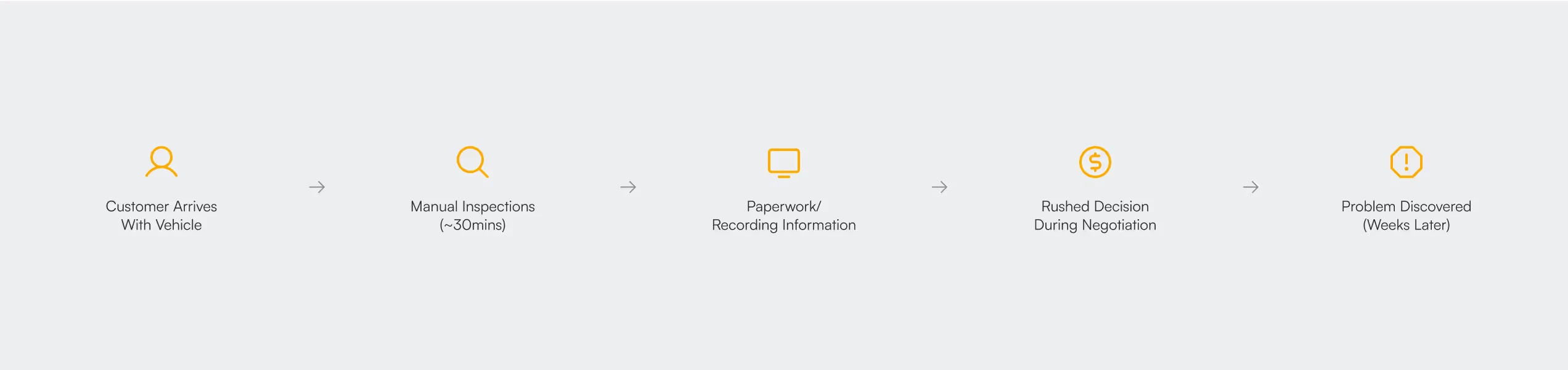
Saturday at Metro Honda. Sarah needs the sale, so she says yes to $18,000 for the customer's Accord. On Monday, inventory finds out it's worth $14,500.
- $3,500lost on one trade-in, and it lands on someone else’s desk
- 30+ minof manual inspection for every appraisal
- 1K+/dayWith trade-ins like this across US dealerships, the industry calls the loss “negative equity.”
experience isn't enough when you're guessing blind
What an appraiser knows
- book value
- what they can see on the lot
- gut feel, under time pressure
What the price actually depends on
- how many similar cars are on nearby lots
- what competitors charge and how fast they sell
- how this model performs at this dealership
- the margin needed to hit targets
- how fast the car needs to move
The idea
point, record, appraise
Built for salespeople like Sarah at Metro Honda, who appraise trade-ins between customers. All it takes is a phone and a plug-in OBD device. No training, no forms.
- 01 PointThe app tells Sarah exactly what to film.
- 02 RecordAI tags damage, reads the VIN, and listens as she talks.
- 03 AppraiseA price range, with every reason behind it.
The experience
the AI does the noticing
01“hey, show me the vehicle”
A simple interface that interacts like a colleague.
- Sarah
- Taps start and walks to the car.
- Interface
- Waits, then starts a guided walk-around.
02“oooh, I see a dent”
As Sarah films, the interface names what it sees (wheels, dents, scratches) and asks for a closer look when it needs one.
- Sarah
- Walks around and talks.
- Interface
- Reads the VIN, tags damage, and turns her speech into notes.
03beyond what eyes can see
Sarah plugs the OBD into the port under her dashboard. The app detects it instantly.
- Sarah
- Plugs the OBD into the port under the dashboard.
- Interface
- Detects it over Bluetooth and flags a misfire on cylinder 3, an O2 sensor that isn't switching, and an evap leak.
04a price that shows its working
$15,850–$16,200, and exactly why. One sheet for Sarah, and a shareable one for the customer.
- Sarah
- Reviews it and shares it.
- Interface
- Combines market, condition, and business needs.
The twist
the trade-in nobody is looking for
A week later, Mike in the service bay films a customer's 2022 Pilot for a routine check-in, like always.
Smart Appraisal is watching. It spots a well-kept SUV with $7,000 of equity, then pings Sarah and texts the customer their car's value. Sarah walks over to a warm conversation, not a cold pitch.
$150 becomes $45,000+
An oil change appointment becomes a new-car sale.
What it changes
from estimators to advisors
- 30 min →becomes under 5Per appraisal, using just a phone and an OBD plug.
- One shared truthSales, service, and inventory work from the same data, so no negative-equity surprises.
- No black boxEvery number shows its reasons, so the customer trusts it.
Takeaways
what I'd carry forward
- Make AI feel familiarHide complex analysis behind something people already know how to use.
- Look next doorThe real opportunity was in the service bay, not the trade-in desk.
- Show the workingExplaining how it decides turns a black box into a trusted advisor.