More trust, more delight, more backend gross.
Delivery Studio turns the Finance & Insurance (F&I) office, the part car buyers dread most, into a guided ownership session. Same paperwork, same product, a completely different room.
- Role
- Concept, UI & Prototype
- Team
- Sleeper Sell, 4 designers
- Timeline
- 18 hrs, concept to prototype
The problem
the journey falls off a cliff at F&I
Buying a car builds to a high: research, the quote, the test drive, shaking hands on the deal. Then the customer is walked into the F&I office and the mood crashes. Four things get worse at once.
Customer mood climbs from curious at research, hopeful at the quote, excited at the test drive, to confident at deal agreement. At F&I it drops off a cliff to anxious and suspicious, lower than where the journey started.
why it crashes: the paperwork lands right at the emotional peak
- Context
- I'm getting my new car becomes I'm stuck in paperwork
- Physical
- The car and the showroom becomes A small, dull office
- Cognitive
- I know exactly what I'm getting becomes I'm signing 14 pages I don't understand
- Control
- I'm in the driver's seat becomes I'm waiting on someone else
The classic F&I menu sums it up: four columns of coverage tiers, fine print in every cell, and a payment at the bottom of each. It asks the customer to price risks they can't picture yet.
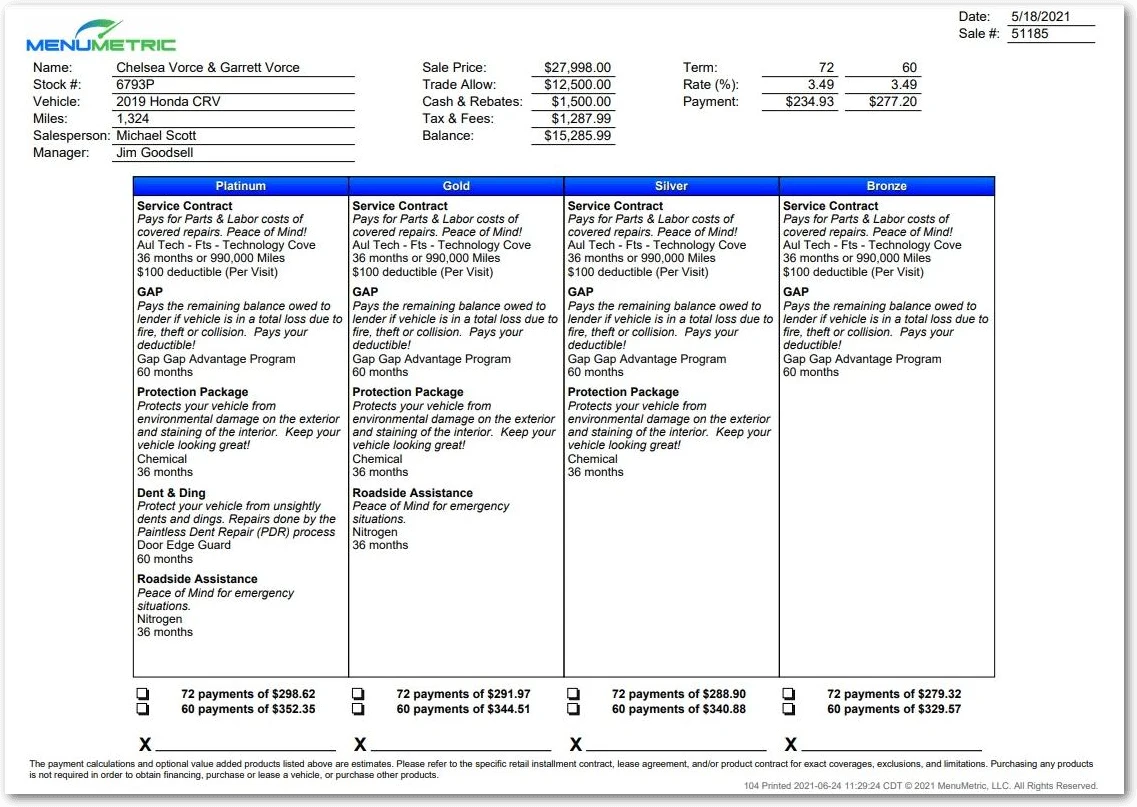
and it's where dealers make their money
- $1,989average F&I gross per vehicle, first half of 2026
- ~79%of the gross on each car deal, while front-end gross shrinks
Source: StoneEagle
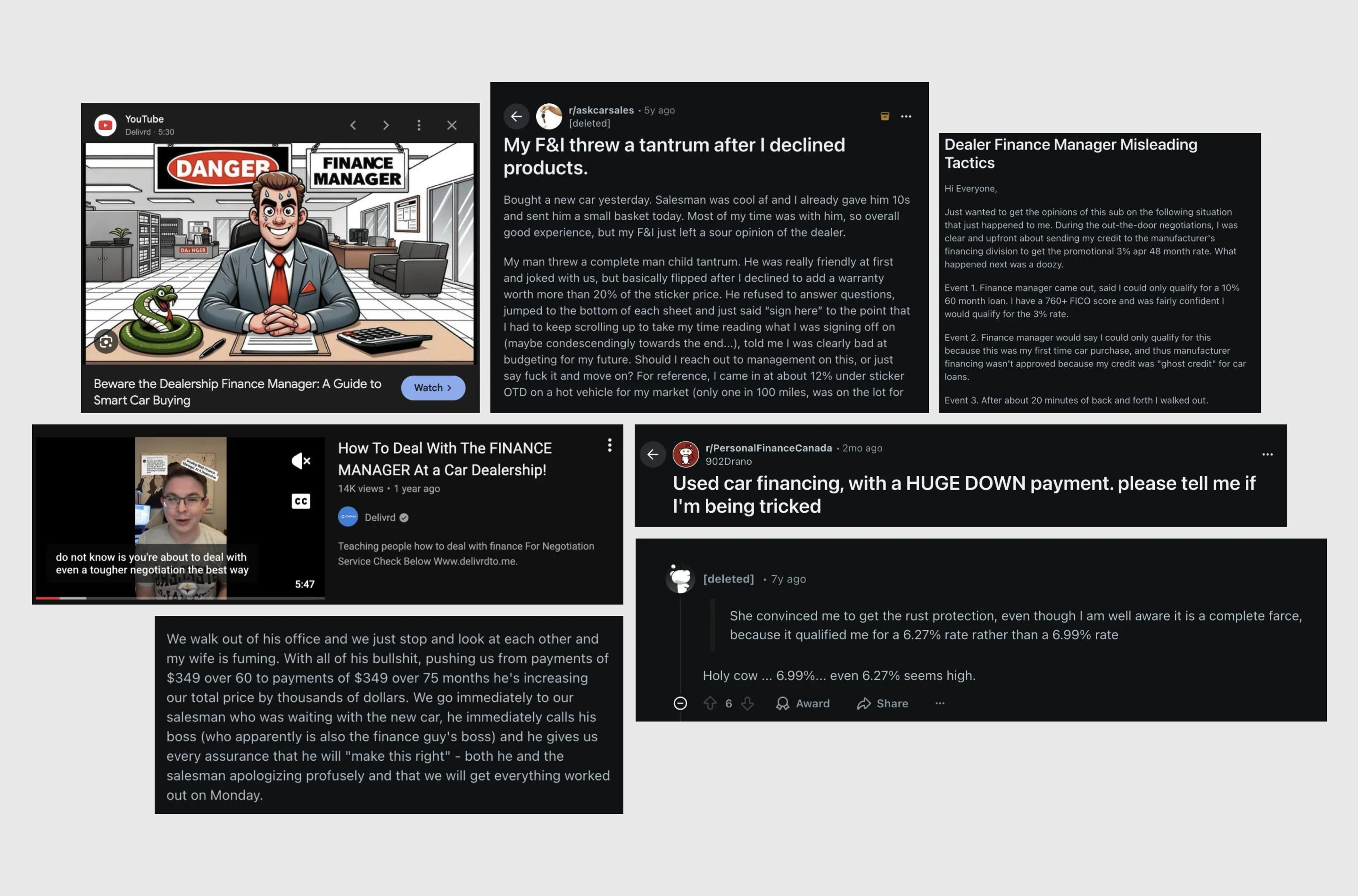
So the F&I manager spends the session defending instead of guiding. And a bad experience here costs real money: fewer products attached, more cancellations later, and less trust in the store.
Principles
AI-first, story-led, human-friendly
Three insights shaped every screen, and one rule set the order: people buy on emotion and justify with logic. We give them both, in that order.
- We trust algorithmsPeople pay 2x surge on Uber without arguing, because a system set the price, not a person. A recommendation backed by data reads as fair. The same line from a salesperson reads as a pitch.
- Complexity killed the catWe buy what we understand. A coverage term means nothing until it's tied to a moment: a cracked windshield in the first three years, a repair bill over $1,500 in year four or five.
- We don't buy from people who sellStart from the customer's job to be done. They aren't shopping for a service contract. They want to own this car without nasty surprises.
The experience
seven steps, from welcome to drive-off
There's nothing to capture or set up: the deal, the vehicle photo and the customer's license all come from the DMS.
01welcome
The studio opens on an image of the customer with their new car. Emotion first.
- Advisor
- Sits down beside the customer.
- Interface
- Waits, then starts a guided walk-around.
02sign the basics
Transfer of ownership, DMV forms and the other required paperwork get signed up front. What's left after that is choice, not obligation.
- Advisor
- Steps in to answer questions as they come up.
- Interface
- Sums up what each signature commits you to.
03the talk
A conversation about how the customer will use the car and how long they'll own it.
- Advisor
- Asks how the customer will use the car, and how long they'll keep it.
- Interface
- Leads the questions, or listens while the advisor asks.
04see the ownership journey
The years ahead, plotted as a graph. Each moment carries a plain-language insight for owners like them, such as: about 65% of new-car owners in California have a non-warranty claim (tires, glass, keys) in the first three years. Logic second.
- Advisor
- Walks them through the years ahead.
- Interface
- Backs each moment with what owners like them faced.
05choose
Bundled products show up as answers to moments on the graph, not as a menu.
- Advisor
- Helps them choose cover for the moments on their graph.
- Interface
- Builds bundles to their car, driving and region inside dealer and compliance rules.
06sign with confidence
Sign everything online, with AI summarising each document in plain language first.
- Advisor
- Steps in to answer questions as they come up.
- Interface
- Sums up what each signature commits you to.
07celebrate
The customer drives away with a personalised closing video.
- Advisor
- Hands over the keys and marks the moment with the customer.
- Interface
- Puts together a closing video the customer can keep and share.
Key decisions
who asks the questions?
The hardest call was how much of the AI to show. We debated whether the AI or the advisor should lead the conversation.
- AI leads
Works: Consistent questions, every intent captured.
Breaks: The customer talks to a screen while a person sits next to them.
- Advisor leads
Works: Natural, and builds on the advisor's rapport.
Breaks: Nothing, as long as the AI listens and takes notes.
We kept AI-led questions and added a listen-only mode. The advisor asks in their own words; the AI listens, takes notes on usage and ownership intent, and shapes the ownership view from them. The human stays in the room and in charge, recommendations keep their data-backed credibility, and advisors don't learn a new script.
How it was built
AI shows up twice
Inside the product, and in how we made it.
01in the product
- Conversational AI
- Captures usage and ownership intent.
- Predictive models
- Estimate repair odds by vehicle, driver and region, and build bundles within dealer and compliance rules.
- Generative AI
- The customer-with-car image, timeline copy, document summaries and the closing video.
02in how we made it
- Research
- TekionGPT, Claude
- Ideation
- Figma AI
- Build & Deploy
- Cursor, Vercel
Concept to working prototype took 18 hours, and I vibe coded the build. Sleeper Sell was an all-design team of four: Punit, Mani, Palash and myself. We demoed a real flow on a tablet, not a slideshow.
Outcome
semi-finals, then a no
We pitched a win for all three sides and a light path to a pilot. This is the impact we pitched; none of it shipped.
- CustomerFeels in control and celebrated, not sold to. Understands what they buy.
- DealerHigher attach rates on the right products. Fewer cancellations, stronger CSI and NPS.
- TekionA new SKU, a signature AI-first differentiator in F&I, and AI components reusable in other journeys.
the go-live plan
A web-based studio wired into Tekion's CRM, DMS (Sales, Service, F&I), lender data and e-contracting. Pilot in one or two stores, A/B tested against traditional F&I on product penetration, time spent and customer satisfaction.
why it stopped at the semi-finals
- Too futuristicIt couldn't drop into today's stack plug-and-play.
- No developer on the teamFour designers could show the experience, but not a credible integration plan.
Takeaways
what I’d do differently
- Design the integration, not just the experienceA vision gets judged on how it lands in today's product. Next time I'd bring an integration map: which systems we read from, what's new, what's reused.
- Bring an engineer in earlyNot for the prototype. For the answer to “how does this plug in?” in the room.
- Lead with a thin sliceSeven AI moments is a big ask. Plain-language document summaries, or the ownership timeline inside today's F&I flow, would have been an easy first yes, with the full studio as the roadmap.